Microtome Suppliers in Brunei: What Laboratories Should Know
Laboratories evaluating microtome suppliers in Brunei need equipment that supports repeatable tissue sectioning, safe daily operation and a dependable supply relationship. A microtome is a core histology instrument: section quality influences staining, microscopic interpretation and the efficiency of the diagnostic workflow.
Micron Instrument Industries, operating under the Micron Optik brand, is an Indian manufacturer of microscopes and histopathology laboratory equipment with its manufacturing headquarters in Ambala, Haryana, India. The company traces its manufacturing history to 1966 and reports six decades of experience serving customers and exporting equipment internationally. The company has also described its presence and offices in Canada and the United States; buyers should confirm the appropriate regional contact, commercial terms and service arrangements for their location.
What Is a Microtome and How Does It Work?
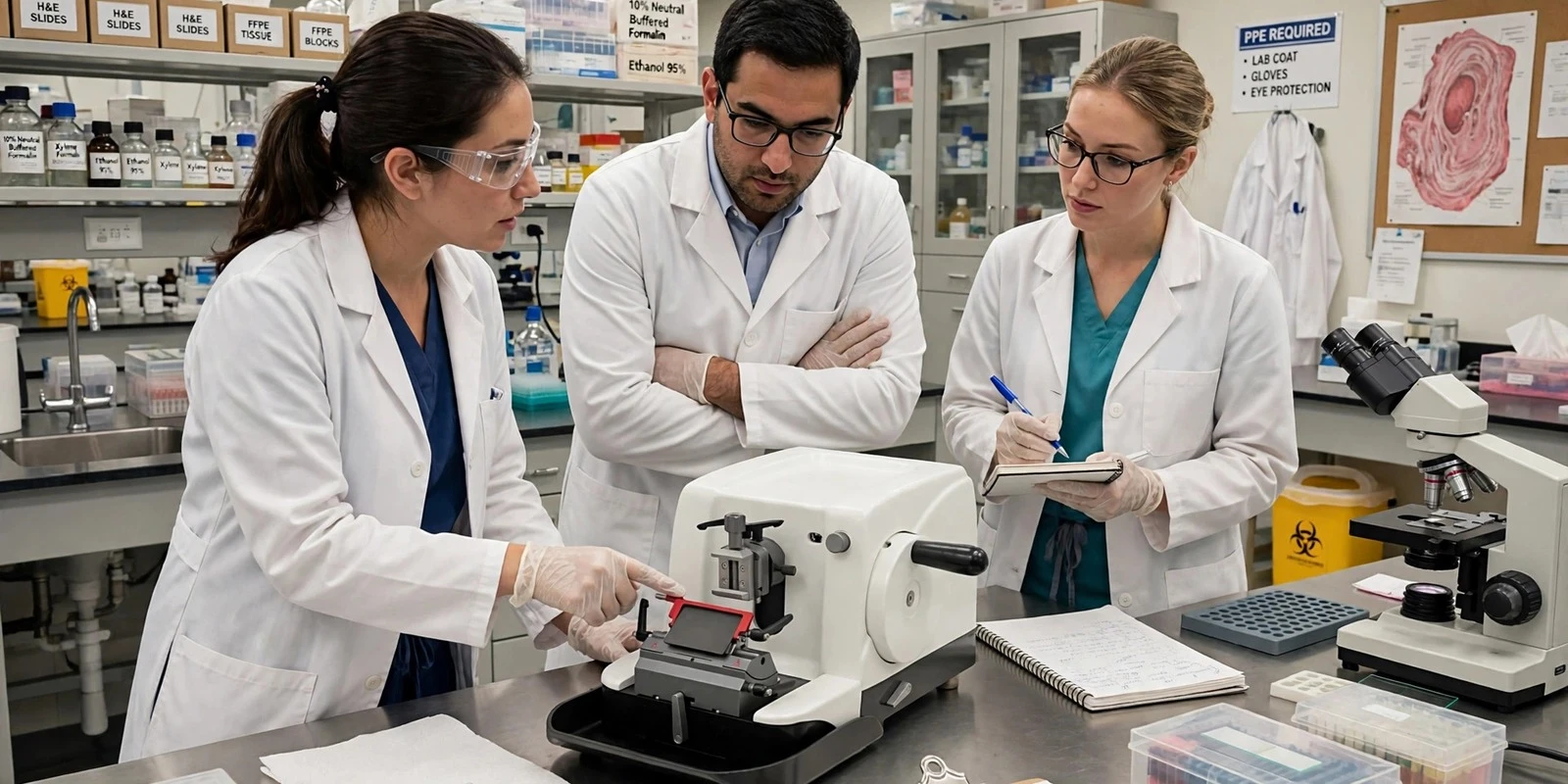
A microtome is a precision instrument used to cut very thin, controlled sections from a specimen. In routine histopathology, tissue is commonly fixed, processed, embedded in paraffin wax and trimmed into a block. The block is secured in a specimen holder and advanced toward a sharp blade by a controlled feed mechanism. As the handwheel or motor drives the cutting movement, thin sections are produced for transfer to a glass slide, staining and microscopic examination.
Section quality depends on several factors working together: the condition and angle of the blade, the rigidity of the instrument, the accuracy of the specimen feed, correct block preparation, paraffin properties, section thickness settings and the operator's technique. A stable microtome helps reduce avoidable artefacts such as compression, chatter, folds and uneven ribbons, although specimen preparation and technique remain important.
Common Microtome Types and Their Uses
Before choosing among microtome suppliers in Brunei, consider the main instrument types and how they fit the workload:
Manual rotary microtomes: a practical choice for routine paraffin sectioning, teaching laboratories and facilities that value direct operator control.
Semi-automatic microtomes: combine operator control with motor-assisted sectioning or feed functions to support repeatability and reduce repetitive effort.
Fully automatic microtomes: offer motor-driven sectioning and electronic controls that can help standardise workflows in higher-throughput laboratories.
Special-purpose instruments: sledge, sliding or cryostat microtomes may be appropriate for larger, harder, frozen or otherwise specialised specimens; confirm the exact application before procurement.
How Microtomes Are Manufactured and Quality-Checked
Microtome manufacturing combines mechanical engineering, precision fitting, component sourcing, assembly and performance verification. The exact process varies by design, but buyers can ask manufacturers how they control the elements that directly affect sectioning accuracy and service life.
Design and engineering: establish the section-thickness range, specimen travel, feed geometry, ergonomics, guarding and service access for the intended application.
Structural parts and machining: the base, guideways, mounts and other load-bearing components must provide rigidity and maintain alignment. Machining and finishing tolerances influence smooth movement and stability.
Feed and drive assembly: the feed mechanism, lead screw or equivalent advancement system, bearings, handwheel and—where fitted—motor and drive electronics are assembled to provide controlled specimen movement.
Blade holder and specimen clamp: these parts must hold the blade and block securely, support adjustment and permit safe handling. Compatibility with the laboratory's preferred blade format should be checked.
Electrical and control integration: semi-automatic and automatic models require verification of motor operation, display functions, control response, alarms and emergency-stop functions where fitted.
Inspection and functional testing: manufacturers should check mechanical movement, feed operation, safety locks and the relevant controls. Ask what final inspection records, warranty terms and user documentation accompany the instrument.
A responsible buyer should avoid assuming that every microtome uses the same materials, production route or test protocol. Ask for model-specific specifications, applicable certificates, installation requirements, maintenance guidance and a demonstration or sample-sectioning assessment where practical.
Applications in Histopathology, Research and Education
Microtomes are used in hospital pathology departments, independent diagnostic laboratories, medical colleges, veterinary laboratories, pharmaceutical research and academic life-science facilities. In Brunei, laboratories should select a configuration based on their actual case volume, sample types, staffing and downstream staining or imaging workflow rather than relying on a generic 'best microtome' label.
Routine diagnostic histology: preparing paraffin-embedded biopsy and surgical tissue sections for staining and microscopic review.
Special stains and immunohistochemistry: producing sections with suitable consistency for protocols where section thickness can influence interpretation.
Research and teaching: preparing repeatable sections for experiments, demonstrations and supervised histotechnology training.
Veterinary and pharmaceutical work: sectioning tissue from animal specimens and research studies according to the laboratory's validated procedures.
Choosing the Right Model from Micron Optik
Micron Optik offers three microtome models that buyers can compare against their workload and preferred level of automation. Review the published specifications and request confirmation of configuration, accessories, warranty and service arrangements before ordering.
See the complete Micron Optik microtome range (https://microscopes-india.com/subcategory/microtomes) to compare available instruments.
Why Micron Instrument Industries Can Be a Good Fit
For laboratories in Brunei, Micron Instrument Industries may be worth shortlisting when the objective is to source histopathology equipment from an established manufacturer rather than evaluate a single instrument in isolation. The company's manufacturing base is in India, its Micron Optik range includes manual, semi-automatic and fully automatic microtomes, and it has stated a manufacturing and export history dating to 1966.
A focused histopathology range: microtomes can be considered alongside related equipment such as tissue processors, embedding stations and tissue flotation baths.
Choice of operating style: compare manual, semi-automatic and automatic configurations to match throughput and operator preferences.
Export experience: the company reports supplying customers internationally; ask for destination-specific shipping, documentation, import and payment details.
Regional contact route: the company has described presence and offices in Canada and the United States. Confirm which office or representative handles enquiries for your market and whether local service is available.
Pre-purchase clarity: request a formal quotation, technical compliance sheet, list of standard accessories, warranty conditions, lead time, training options and recommended spare parts.
A supplier should be selected on evidence, not marketing language alone. Ask for a live demonstration or reference installation where possible, compare the exact specifications against your requirements and verify that the proposed configuration meets applicable local procurement and regulatory rules.
Procurement Checklist for Buyers in Brunei
Define the specimen types, typical section thickness and expected blocks per day.
Compare manual, semi-automatic and automatic operation based on workload and available staff.
Check section-thickness increments, specimen travel, retraction features, blade compatibility and specimen orientation.
Inspect handwheel locking, blade guarding, emergency-stop and other model-specific safety features.
Confirm installation, operator training, warranty, maintenance, spare parts and service response arrangements.
Request current quotations, packing details, delivery lead time and any documentation required for import or institutional procurement.
Frequently Asked Questions
What does a microtome do?
It cuts thin, controlled sections of tissue or other specimens for examination under a microscope. In histopathology, paraffin-embedded tissue is commonly sectioned and mounted on slides for staining.
Which microtome is suitable for a pathology laboratory?
The answer depends on daily workload, specimen type, required section thickness, staff experience and desired automation. Compare manual, semi-automatic and fully automatic models against those needs.
How can I evaluate microtome suppliers in Brunei?
Ask for model-specific specifications, a formal quotation, warranty and service terms, installation and training details, references where available, and a clear plan for spare parts and technical support.
Does Micron Optik offer more than one microtome model?
The Micron Optik website lists the MARM-MT manual rotary, MARM-ST semi-automatic and MARM-AT fully automatic microtomes. Check the linked product pages for current specifications and availability.
What should be checked before ordering from an overseas supplier?
Confirm the exporter of record, Incoterms, shipping and insurance, customs documents, import requirements, payment terms, warranty coverage and who will provide technical support in the destination market.
Conclusion
Finding the right microtome suppliers in Brunei means balancing sectioning performance, safety, workflow fit and long-term support. A well-matched microtome can contribute to consistent histology preparation, but the final decision should be based on technical documentation and a clear understanding of the laboratory's needs. Micron Instrument Industries, through Micron Optik, offers manual, semi-automatic and fully automatic models and brings a stated manufacturing history dating to 1966. Review the linked models, ask for a tailored quotation and confirm the service arrangements applicable to your location.
Related reading: Microtome Manufacturers in India – Complete Guide (https://microscopes-india.com/blog/microtome-manufacturers-in-india) | Contact Micron Optik (https://microscopes-india.com/)